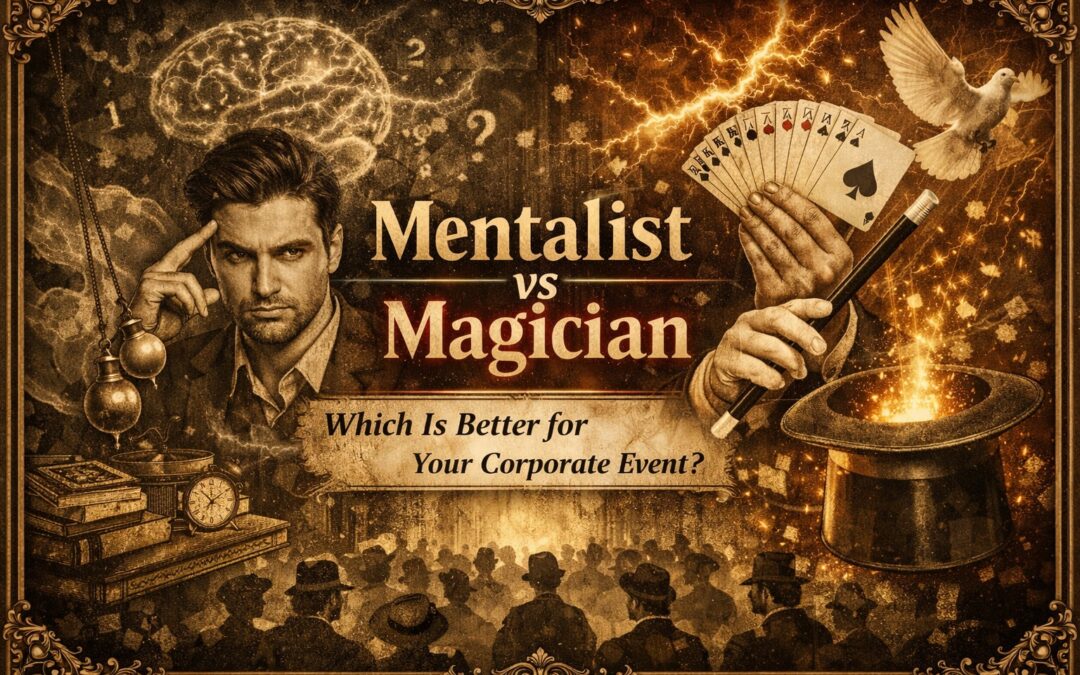
A comparison of mentalism and magic showing the psychological mystery of a mentalist versus the visual illusions of a magician for corporate events.
Mentalist-vs-Magician
When event planners start looking for entertainment, one of the most common questions they ask is:
“What’s the difference between a mentalist and a magician, and which one is better for my event?”
While both can be incredible performers, the experience they create for your guests can be very different. Understanding that difference can help you choose entertainment that perfectly matches the tone of your event and the reaction you want from your audience.
What Does a Magician Do?
A traditional magician performs visual illusions and sleight-of-hand tricks designed to entertain and amaze.
This might include:
- Card tricks
- Coin magic
- Objects appearing or disappearing
- Classic stage illusions
Magic is designed to create moments where the audience thinks:
“How did they do that?”
It’s fast, visual, and often highly theatrical.
For many events, especially family gatherings or casual parties, magic can be a fantastic choice.
But corporate audiences often want something that feels a little different.
What Does a Mentalist Do?
Mentalism is a performance style that explores the power of the mind, psychology, and intuition.
Instead of focusing on physical tricks, a mentalist creates demonstrations that feel like they are happening inside the audience’s thoughts.
For example, during my corporate performances I often demonstrate things like:
-
Drawing Duplication – Someone thinks of an image and draws it privately. Moments later I reveal the exact drawing they created.
-
Thought-Of Name Revelation – A guest simply thinks of the name of a family member or close friend, and I reveal the name without them ever saying it aloud.
-
Hypnosis Demonstrations – Using suggestion and hypnotic techniques, volunteers can perform things they normally couldn’t, such as becoming temporarily impervious to pain, losing physical strength, or solving complex calculations.
-
Predictions Made Before the Show – A sealed prediction made earlier in the evening correctly predicts decisions made by audience members during the performance.
-
Multiple Mind Reading – Several people in the audience think of different pieces of information simultaneously, and each one is revealed correctly.
-
Psychological Influence Experiments – Guests make seemingly free choices that appear to have been subtly influenced moments earlier.
-
Number Divination – Someone freely thinks of a number, and I reveal it without asking any direct questions.
-
Book Test – A participant chooses a random word from a book they are holding, and I reveal the exact word they are thinking of.
-
Lie Detection Demonstrations – I attempt to determine when someone in the audience is lying or telling the truth using subtle psychological cues.
-
Remote Viewing – A volunteer focuses on a location, object, or drawing, and I describe details of what they are visualizing.
-
Psychometry – Borrowed personal objects are mixed together, and I attempt to match each object back to its owner using intuition and observation.
-
Audience-Wide Mind Reading – The entire audience thinks of information at the same time, and multiple thoughts are revealed during the routine.
-
Impossible Coincidences – Two audience members make random choices that somehow match perfectly.
-
Time Prediction – Someone freely names a time, and it matches a prediction made long before the show began.
-
Memory and Calculation Feats – Demonstrations that show the incredible potential of the human mind, such as rapid calculations or remembering large amounts of information.
One of the biggest reactions I consistently see comes from mind-reading moments.
When someone thinks of something personal, a name, a drawing, or a memory, and it is revealed accurately, the entire room goes silent for a moment before reacting.
Those are the moments that people remember.
The Key Difference Audiences Feel
From my experience performing at corporate events, the biggest difference between a mentalist-vs-magician is how the audience processes what they are seeing.
With magic, the audience usually understands that they are watching a trick.
They suspend disbelief and enjoy the illusion.
With mentalism, the reaction is very different.
It sits on a fine line between entertainment and something that feels almost real.
Guests often leave the show wondering:
- “How could he possibly know that?”
- “Was that psychological?”
- “Could that actually be real?”
Instead of asking how the trick worked, they question what just happened.
And that changes the entire conversation after the show.
Why Mentalism Creates More Conversation
One of the things I notice most after corporate events is how people talk about the performance afterward.
Instead of saying:
“That was a cool trick.”
Guests tend to say things like:
- “There’s no way he could have known that.”
- “He named the person I was thinking of.”
- “How did that drawing match perfectly?”
Mentalism forces people to question the reality they just witnessed.
Those conversations can last the entire night, and sometimes long after the event is over.
For corporate events, that kind of shared experience can be incredibly powerful.
Why Mentalism Works So Well for Corporate Events
Corporate audiences are very different from family audiences.
They tend to prefer something that feels:
- More psychological
- More interactive
- More sophisticated
Mentalism requires the audience to pay attention and participate.
In my shows, guests are actively involved in the demonstrations rather than simply watching from their seats.
For example, during hypnosis demonstrations I don’t use hypnosis to make people do silly things.
Instead, I use it to demonstrate the extraordinary abilities of the mind.
Participants might suddenly:
- Become impervious to pain
- Lose their physical strength
- Perform scientific mathematical calculations they normally couldn’t do
These demonstrations show the incredible potential of the human mind, which tends to resonate strongly with professional audiences.
A Moment the Entire Room Experiences Together
One of my favorite parts of performing mentalism is the moment when the entire room reacts together.
During my shows, I often perform qualification processes where several audience members begin going through hypnotic induction.
As people around them watch the process unfold, the entire room becomes part of the experience.
When those moments land correctly, you can feel the energy shift across the whole audience.
Those shared reactions are what turn a performance into a memorable event.
Common Mistakes Event Planners Make When Choosing Entertainment
After performing at corporate events for many years, I’ve noticed that when entertainment doesn’t work well at an event, it’s usually not because the performer was bad.
It’s because the wrong type of entertainment was chosen for the audience.
Corporate entertainment should do more than fill time between dinner and speeches. It should create moments that guests talk about long after the event is over.
Here are a few common mistakes I often see when event planners are choosing entertainment.
Hiring Based Only on Price
Entertainment is often one of the most memorable parts of an event. Yet many planners start their search by asking only one question:
“What does it cost?”
While budgets are always important, choosing entertainment based purely on price can be risky.
Two performers may appear similar on paper, but the experience they create for your guests can be completely different.
An experienced performer understands how to read a room, engage an audience, and create moments that feel genuinely memorable.
As with most things in life, you tend to get what you pay for.
Choosing Entertainment That Turns Guests Into Spectators
Many forms of entertainment simply ask guests to sit back and watch.
There’s nothing wrong with that style of performance, but for corporate events it can sometimes create a passive atmosphere where guests become spectators rather than participants.
Mentalism works very differently.
In my shows, the audience becomes part of the experience. People are thinking of names, making choices, drawing images, and participating in demonstrations happening right in front of them.
When the audience is actively involved, the experience becomes far more personal and memorable than simply watching a show from a distance.
Choosing Entertainment That Doesn’t Match the Audience
Another common mistake is choosing entertainment that doesn’t align with the tone of the event or the expectations of the audience.
Corporate audiences are very different from family audiences.
Professionals tend to enjoy experiences that feel more sophisticated, intriguing, and psychologically engaging.
They’re often looking for something unique, something they haven’t seen before.
Mentalism tends to resonate strongly with adult audiences because it creates that sense of mystery and curiosity.
Instead of simply seeing a trick, guests experience something that feels intelligent, interactive, and genuinely thought-provoking.
And that’s often what makes an event stand out.
So Which Is Better for Your Event?
The real answer is:
It depends on the experience you want your guests to have.
A magician may be the perfect choice if you want:
- Fast-paced visual entertainment
- Classic illusions
- A traditional magic show experience
A mentalist may be a better fit if you want:
- Psychological entertainment
- Audience participation
- Guests talking about the experience long after the event
If your goal is to create a moment where people genuinely question what the human mind might be capable of, mentalism can create an experience unlike anything else.
Final Thoughts
Both magicians and mentalists can deliver incredible entertainment.
But they create very different experiences.
Magic tends to make people ask:
“How did the trick work?”
Mentalism makes people ask something much more interesting:
“Could that actually be real?”
And those are the moments your guests will be talking about long after the event ends.
Michael Hamond
Recent Comments