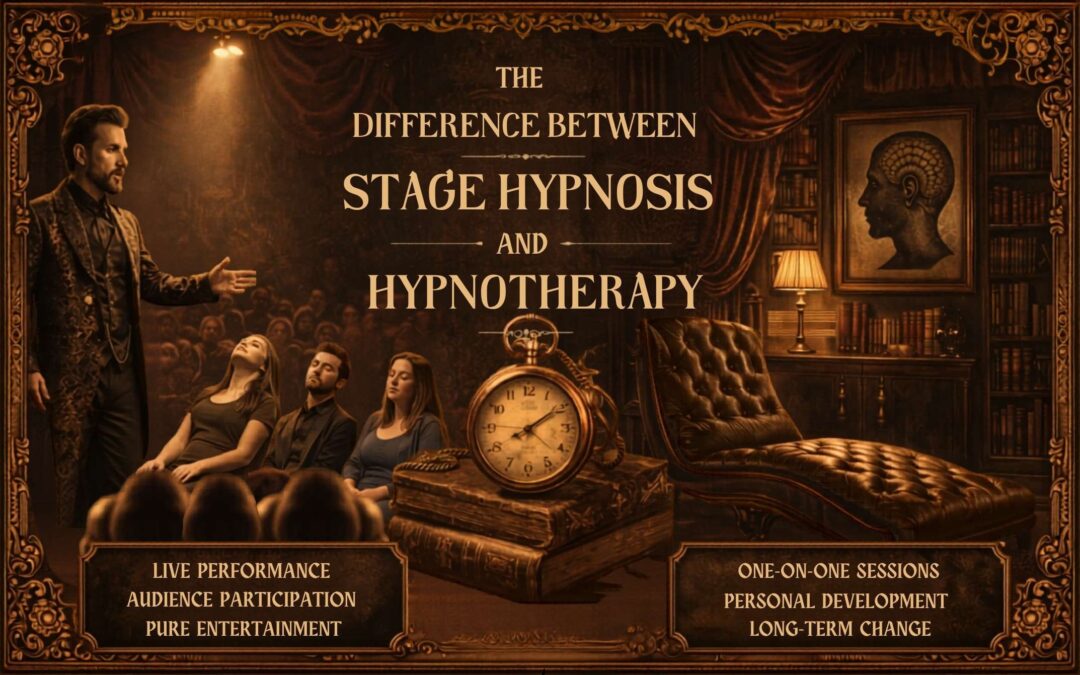
A live stage hypnosis performance demonstrating audience participation and engagement
The Difference Between Stage Hypnosis and Hypnotherapy
If you’ve ever watched a hypnosis show and wondered how it compares to something like hypnotherapy, you’re not alone. The difference between stage hypnosis and hypnotherapy is one of the most common questions I get after a performance.
People see someone on stage doing something unexpected, sometimes hilarious, sometimes impressive, and naturally start asking: Is that the same thing used to help people quit smoking or change habits?
The short answer is no, but the full answer is far more interesting.
The Core Difference Between Stage Hypnosis and Hypnotherapy
At a surface level, the difference between stage hypnosis and hypnotherapy comes down to intent and environment.
Stage hypnosis is designed for entertainment. It happens in front of a group, moves quickly, and is built around creating a shared experience for an audience.
Hypnotherapy, on the other hand, is focused on personal change. It typically takes place in a one-on-one setting, often over multiple sessions, and is designed to help someone work through specific challenges like habits, stress, or behavioral patterns.
The techniques may share similarities, but the purpose is completely different.
Why People Often Confuse Stage Hypnosis and Hypnotherapy
One of the biggest misconceptions I hear is that because I’m a stage hypnotist, I must also be able to help someone stop smoking or change long-term habits.
That’s not what a show is designed for.
Hypnotherapy is a structured process that happens over time in a controlled environment. A stage hypnosis show is built for engagement, speed, and group dynamics. It’s about creating a moment, not long-term change.
What’s interesting is that the misunderstanding usually comes from how real the experience feels. People will come off stage saying, “I knew what I was doing, but I couldn’t stop myself from going along with it,” and that blurs the line in their mind between entertainment and therapy.
There are also some common misconceptions about hypnotism that can shape how people view both stage hypnosis and hypnotherapy (read here).
What Actually Happens Before a Stage Hypnosis Show Begins
Another key part of understanding the difference between stage hypnosis and hypnotherapy is realizing that a stage show doesn’t start when someone is called up, it starts the moment the audience walks into the room.
Everything from the atmosphere to the pacing is designed to put people in a more relaxed and open state. The goal isn’t to overwhelm people, it’s to make them comfortable enough to engage.
You’ll have people in the room who want to be on stage, and others who are happy to watch. That doesn’t make one group more skeptical than the other, it usually comes down to comfort levels. If someone isn’t comfortable being the center of attention, they’re unlikely to fully engage, even if they volunteered.
From there, I begin the process of identifying who is actually responding before they ever step on stage. People are far more relaxed in their seats than they are under a spotlight, and you can quickly see who is following instructions and allowing themselves to go along with the experience.
By the time someone steps up, the process is already underway.
What Stage Hypnosis Reveals About the Mind
The most powerful moments in my shows aren’t when someone does something funny, they’re when someone surprises themselves.
While many hypnosis shows focus heavily on comedy, my approach leans more toward showing what the mind is capable of. There are still entertaining moments, people might forget something or respond in unexpected ways, but the focus is always on what that reveals, not just the reaction itself.
The real shift happens when someone comes out of hypnosis and realizes what they experienced felt completely real in the moment.
That’s usually when you hear something like, “I knew what was happening, but I couldn’t stop myself from going along with it.”
That moment is the key. It shows that hypnosis isn’t about control, it’s about how easily the mind can accept an idea and act on it when the conditions are right.
Who Responds Best to Stage Hypnosis
From a stage perspective, the people who respond best aren’t defined by a specific personality type. The difference between stage hypnosis and hypnotherapy becomes even clearer here, because stage hypnosis relies heavily on group dynamics and willingness in the moment.
The biggest factor is whether someone is open to the experience. Not in the sense that they believe in hypnosis, but that they’re willing to follow directions and engage.
Focus also plays a role. People who can concentrate, even briefly, tend to respond more quickly than those who are distracted or hesitant.
Some people respond immediately, while others take a little longer. That variation is completely normal and simply reflects how individuals engage differently with suggestion.
From the outside, it may look like certain people are more “hypnotizable,” but in reality, it’s more about how willing and engaged someone is in that moment.
Is a Stage Hypnosis Show Appropriate for Corporate Events?
This is where the difference between stage hypnosis and hypnotherapy really matters for event planners.
A stage hypnosis show is designed to be safe, controlled, and purely entertainment-based. There’s no therapy taking place, no personal issues being explored, and no one is being put in a position where something uncomfortable is going to surface.
The concern I hear most often, especially in corporate environments, is whether it’s appropriate or professional. A lot of people associate hypnosis with making someone look silly on stage, and that hesitation is completely understandable.
That’s where my approach differs.
While there are always fun and entertaining moments, the focus is on creating a positive experience for the participant. If someone forgets something or reacts in an unusual way, that’s never where their story ends. I always bring them back to a moment where they succeed at something unexpected.
They get a “hero moment.”
Instead of walking off stage feeling like they were the joke, they walk off feeling like they were part of something impressive.
For an event planner, that changes everything. It turns the experience into something engaging, memorable, and safe for everyone involved.
Final Thoughts on the Difference Between Stage Hypnosis and Hypnotherapy
The difference between stage hypnosis and hypnotherapy isn’t about one being real and the other not, it’s about purpose.
One is designed for entertainment, shared experience, and engagement.
The other is designed for personal, long-term change.
Understanding that distinction makes it much easier to know what you’re actually seeing on stage, and what kind of experience you’re bringing into your event.
Recent Comments